
%402x.svg)
Most people recognise a valuable location only after it becomes obvious. This typically happens once infrastructure is in place, pricing has already adjusted, and demand is clearly visible. At that stage, the decision to invest feels justified, even safe.
However, in practice, the strongest opportunities rarely exist at that point.
For investors exploring investing in Lombok property or evaluating emerging property markets in Indonesia, the distinction is important. Value is not created when a market becomes visible. It is created earlier, during a phase where the signals are present but not yet fully recognised.
.png)
Read More: Lombok Ranked Among Asia’s Best Islands. What That Actually Signals
Value Does Not Appear Overnight
There is a common perception that property markets grow in sudden phases, that a location “takes off” as a result of a specific trigger, such as a new development or an increase in tourism.
In reality, growth tends to build progressively.
Before pricing adjusts.
Before demand becomes measurable at scale.
Before the location enters broader investor awareness.
What later appears as rapid appreciation is often the result of underlying changes that have been developing over time. These changes are not always immediately visible, particularly in less mature markets where development is uneven and information is fragmented.
This dynamic is especially relevant when analysing property investments in Lombok, Indonesia, where the pace of development does not always align with global visibility, and where early-stage positioning plays a more significant role.

The Signals Most People Overlook
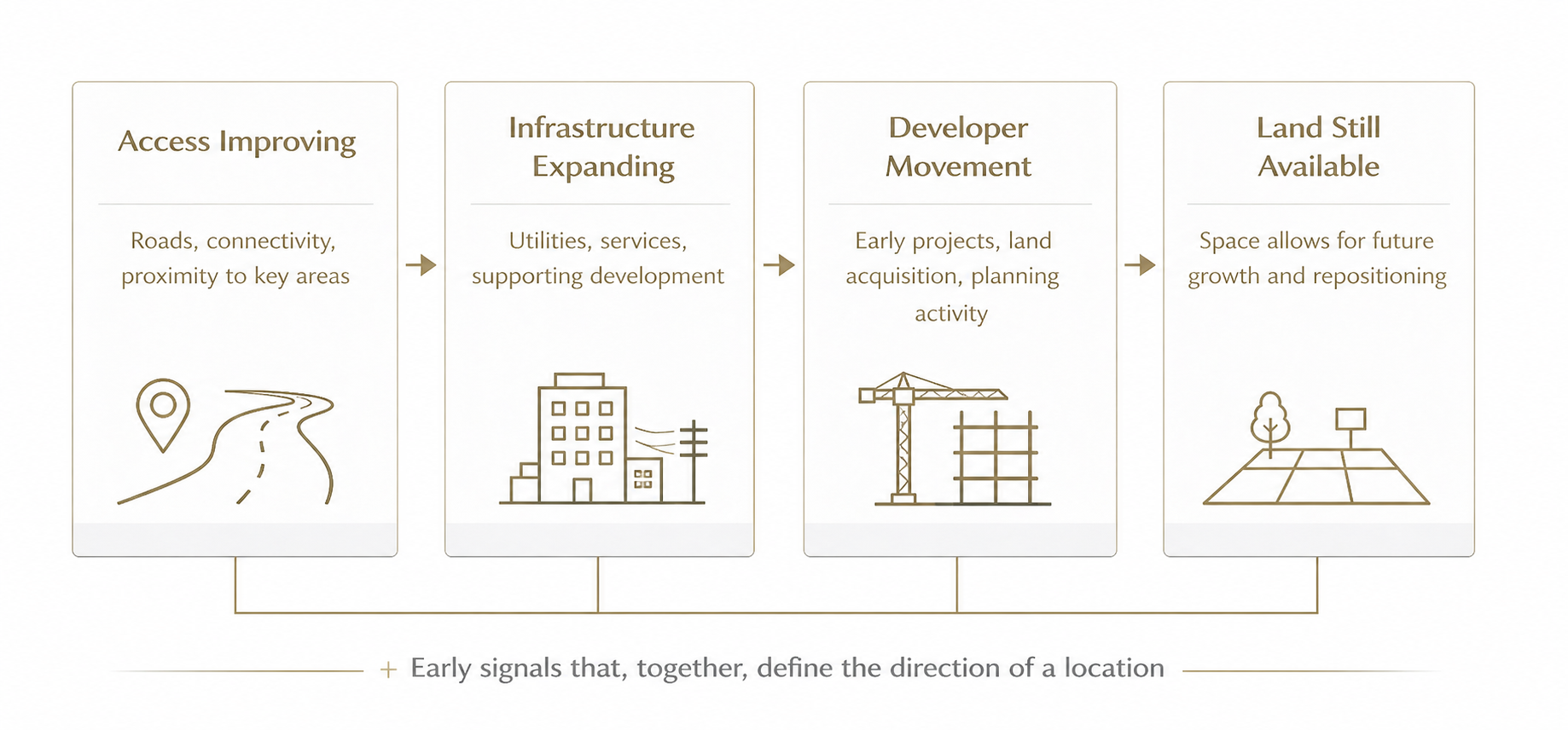
Before a location becomes established, there are usually a number of early indicators. Individually, they may not appear decisive. Taken together, they provide direction.
Access is one of the first elements to evolve. Improvements in road infrastructure, proximity to key areas, and general connectivity tend to precede broader development. These changes gradually reduce friction and increase the viability of a location over time.
Infrastructure follows a similar pattern. Utilities, services, and supporting developments rarely arrive all at once, but instead expand progressively as activity increases. This includes not only physical infrastructure, but also the presence of hospitality, retail, and operational services that support long-term use.
Developer movement is another consistent signal. Early-stage projects, land acquisition, and planning activity often begin well before a location gains wider attention. These actions are typically based on forward-looking assessments rather than current demand.
Finally, the availability of land plays a structural role. In early-stage markets, the presence of undeveloped space allows for repositioning and long-term planning. As a location matures, this flexibility tends to disappear.
Understanding how these elements interact is central to identifying a good investment location before it grows, and more broadly, to defining what makes a location valuable for property investment.
Why Timing Matters More Than Certainty
Most investors tend to wait for confirmation before entering a market. This usually takes the form of proven demand, stable pricing, and a degree of predictability regarding outcomes.
While this approach reduces uncertainty, it also limits potential.
By the time a market reaches this stage, a significant portion of its upside has already been absorbed. Pricing begins to reflect existing demand rather than future potential, and the margin for repositioning becomes narrower.
Early-stage markets, by contrast, operate differently. They involve a higher degree of uncertainty, but they also offer advantages that are no longer available in more mature environments. These include flexibility in entry, the ability to position assets strategically, and exposure to the early phases of market formation.
This trade-off sits at the core of when to invest in emerging property markets. It is not simply a question of risk tolerance, but of understanding how timing influences both entry conditions and long-term outcomes.

Reading a Place, Not Just Looking at It
A location is often evaluated based on its current appearance: its landscape, existing developments, or immediate surroundings. While these elements provide context, they do not fully define its potential.
More relevant is how the location sits within a broader framework.
This includes its relationship to nearby hubs, its accessibility, and its role within a wider development corridor.
It also involves assessing what the location has the capacity to become, rather than what it currently is.
Two areas may appear similar on the surface, yet follow entirely different trajectories over time. One may integrate into a larger ecosystem of growth, while the other remains isolated.
This distinction is particularly important for investors considering where to invest in Indonesia, where surface-level comparisons can be misleading if not supported by a deeper understanding of context.

Context: Emerging Markets Like Lombok
In more mature markets, pricing tends to align closely with existing demand. The gap between perception and value is limited, and opportunities are often incremental rather than transformative.
In emerging markets such as Lombok, this gap still exists.
There is a difference between how a location is currently perceived and what it is to become. This gap is where value is created, but it requires a different approach — one that prioritises direction over immediate clarity.
This is part of the reason why Lombok real estate investments has begun to attract attention among investors looking beyond more saturated destinations. In areas such as the south of the island, including regions often highlighted for South Lombok investment opportunities, the combination of improving infrastructure, ongoing development, and available land creates a different type of investment environment.
Rather than competing within an already defined market, investors are entering at a stage where the market itself is still forming.
Understanding this transition is central to why South Lombok is becoming an investment destination, particularly within the broader landscape of property investment in Indonesia.

The most valuable locations rarely present themselves as such in the early stages.
They become recognisable later, once development is visible, pricing has adjusted, and demand is established.
Identifying them earlier is not a matter of prediction, but of observation.
It requires attention to the underlying changes that precede visible growth, and an understanding of how those changes shape the trajectory of a location over time.
In property investment, value is rarely found at the point where it is most apparent. It tends to emerge earlier, in the phase where direction is clearer than outcome, and where positioning still defines the result.


%402x%20(dark).svg)
%402x%20(dark).svg)

%402x.svg)


