
%402x.svg)
Recognition rarely changes a market overnight.
But it often confirms a direction that has already been forming for some time.
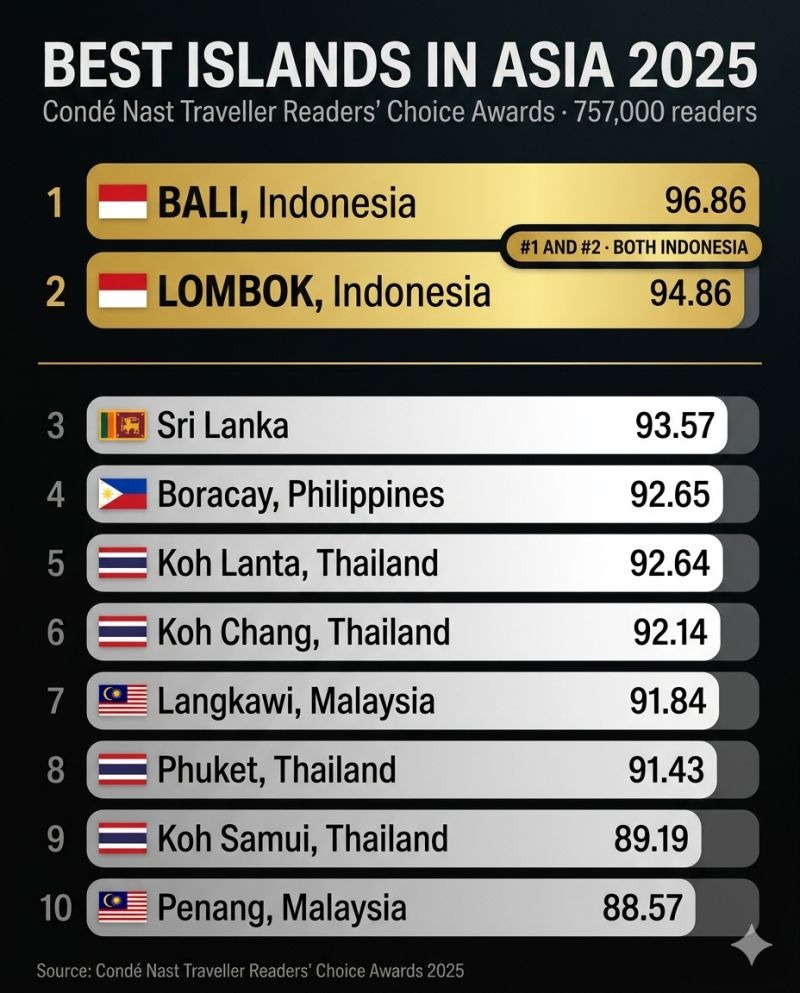
In the latest Condé Nast Traveller Readers’ Choice Awards 2025, Lombok has been ranked the #2 best island in Asia, just behind Bali.
At first glance, it reads as a milestone.
In practice, it is something more subtle: a signal.
Not of arrival, but of recognition.
Visibility Follows Experience
Awards of this nature are not predictive. They are reflective.
They capture how a destination is experienced not how it is marketed. With over 750,000 readers contributing to the rankings, the outcome is shaped by travellers who have already been there, spent time on the ground, and formed their own impressions.
For Lombok, this distinction matters.
The island has never relied on the same level of global visibility as Bali. Its growth has been quieter, more gradual, and often shaped by direct experience rather than broad exposure.
To be ranked at this level suggests that Lombok is no longer being discovered it is being returned to.

Read More: A Quiet Signal of Growth: Lombok’s Expanding Connectivity with Singapore
A Different Kind of Appeal
What continues to define Lombok is not comparison, but contrast.
Where Bali has evolved into a globally recognised destination with dense infrastructure and high activity, Lombok remains more open. Less compressed. More defined by landscape than by development.
This is not a matter of preference, it is a matter of positioning.
Across Asia, many of the islands appearing in the same ranking such as Phuket or Koh Samui represent mature tourism markets. Well-established, highly accessible, and already operating at scale.
Lombok sits at a different stage.
Its appeal is not built on volume, but on space.
Not on density, but on balance.
And increasingly, that distinction aligns with how travel behaviour is evolving globally.

Recognition at an Early Stage
What makes this ranking particularly relevant is timing.
Lombok is still in a phase where its broader identity is forming. Infrastructure is expanding. International access is improving. Development is ongoing but not yet saturated.
In more mature destinations, recognition often follows peak development. In Lombok, it is arriving earlier before the market has fully adjusted.
This creates an unusual dynamic.
Perception is beginning to rise.
But pricing, supply, and positioning have not yet fully caught up.
In property markets, this gap is often where long-term value is shaped.
Beyond the Headline
It would be easy to frame this ranking as a comparison Lombok versus Bali, or Lombok against other destinations in Asia.
But that perspective tends to miss the more relevant point.
The presence of both Lombok and Bali in the top two positions reflects something broader about Indonesia’s role within regional tourism. It suggests a diversification of demand, where travellers are no longer concentrated in a single destination, but are exploring alternatives within the same geography.
For Lombok, this does not mean becoming Bali.
It means becoming more distinctly itself.

What It Means for the Market
In real estate, recognition rarely acts as a direct catalyst.
Its impact is indirect, but cumulative.
It influences perception.
Perception influences attention.
Attention gradually shapes demand.
For investors and developers, the significance lies not in the ranking itself, but in what it represents: a shift in how Lombok is being seen internationally.
This tends to manifest over time through:
- Broader awareness among new buyer segments
- Increased confidence in long-term positioning
- Gradual expansion of hospitality and supporting infrastructure
These are not immediate changes. But they are directional.
A Signal of Maturity in Progress
Perhaps the most important takeaway is not that Lombok has reached a certain level, but that it is being recognised while still evolving.
It remains less saturated than comparable destinations.
Land availability is still relatively open.
The market has not yet standardised.
And yet, it is already being placed among the top destinations in the region.
This combination early stage structure with rising global recognition—is relatively rare.
Looking Ahead
Markets tend to move in phases.
First, infrastructure.
Then access.
Then recognition.
And only later, full-scale maturity.
Lombok is moving through these stages but not all at once, and not in a linear way.
The ranking by Condé Nast Traveller does not define Lombok’s future. But it does offer a clear indication of how the island is currently being experienced and how that experience is beginning to translate into broader visibility.
For those observing the market closely, that visibility is less of a conclusion and more of a reference point.
A moment where direction becomes easier to read.
And where what was once considered peripheral is gradually becoming part of a more established map.
.jpg)


%402x%20(dark).svg)
%402x%20(dark).svg)

%402x.svg)


