
%402x.svg)
For years, the assumption has been simple: when capital moves out of a region, it is fleeing.
If you have been paying attention, you already know that assumption no longer holds.
Because what we are seeing now does not feel like urgency. It feels measured. Intentional. Almost quiet.
Wealth is not leaving. It is repositioning. Not in search of safety, but in search of optionality across jurisdictions, asset classes, and increasingly, emerging markets real estate in Asia.

Beyond the “Safe Haven” narrative
The language of “safe havens” has always been slightly misleading.
It suggests a reaction. Fear. A response to instability.
But that is not how considered capital behaves.
The most sophisticated investors move before the narrative becomes obvious - before headlines, before consensus, before pricing fully reflects opportunity. They are not simply looking for a place to go. They are building the ability to move.
- A second legal base.
- A second jurisdiction.
- A second operational framework.
In today’s landscape, that often translates into exposure to Southeast Asia property investment, where regulatory evolution and economic growth intersect. Not as an alternative, but as an extension of an already diversified portfolio.
Read more: Mandalika SEZ Pushes Strategic Investment with Competitive Incentives
Why is the most interesting capital not going where everyone is looking?
In Indonesia, for real estate investment, Bali remains the obvious choice. Demand is proven, infrastructure is mature, and the narrative is fully established. But that visibility comes at a cost.
Areas like Canggu and Uluwatu are no longer emerging; they are saturated. Land is scarce, yields are compressed, and the market has become increasingly standardized. What was once an opportunity is now a crowded trade.
This is where Lombok enters the conversation.
At a completely different stage of development, Lombok offers what Bali no longer can: early positioning. Land for sale in Lombok is still accessible, beachfront property remains underpriced, and the market is far from saturated.
The shift from Bali vs Lombok investment is no longer speculative; it is strategic.
Forward-thinking investors are not chasing visibility. They are positioning themselves where property investment still offers real upside, stronger rental yield potential, and long-term capital appreciation.

It’s about Structure, not Speculation!
What makes this shift different is that it is not driven by trends, but by structure.
The most relevant question is no longer what you are buying. It is how you are holding it.
In Indonesia, foreign investors can access property through established legal frameworks such as PT PMA Indonesia property ownership or leasehold property Indonesia structures. Understanding freehold vs leasehold Indonesian distinctions is essential, not just for compliance, but for long-term flexibility and capital efficiency.
This is not simply about buying property in Lombok, Indonesia.
It is about establishing a second base within a clear legal system, aligned with Indonesia's real estate laws for foreigners, and complemented by options such as an investor visa, Indonesia property, or KITAS structures.
The asset supports the strategy.
But the structure gives it meaning.
Lombok, at the right moment
Within this broader shift, the Lombok real estate market sits in a uniquely compelling position.
Not undeveloped in the sense of uncertainty, but undeveloped in the sense that its identity is still being shaped.
Entering at this stage is fundamentally different from entering a mature market like Bali. It is not simply about acquiring property for sale. It is about positioning within an emerging Lombok property market, where growth is still ahead of the curve.
Particularly in areas such as the Southern coastline of the island, investors are increasingly identifying early-stage opportunities across land, off-plan villas, and resort developments.
This is where Lombok investment property becomes more than an asset class; it becomes a timing decision.

A structural demand driver: tourism
Indonesia’s international tourism recovery post-COVID tells a broader story.
From approximately 1.6 million international arrivals in 2021 to over 15 million in 2025. This is not cyclical; it reflects structural demand, supported by infrastructure and policy alignment.
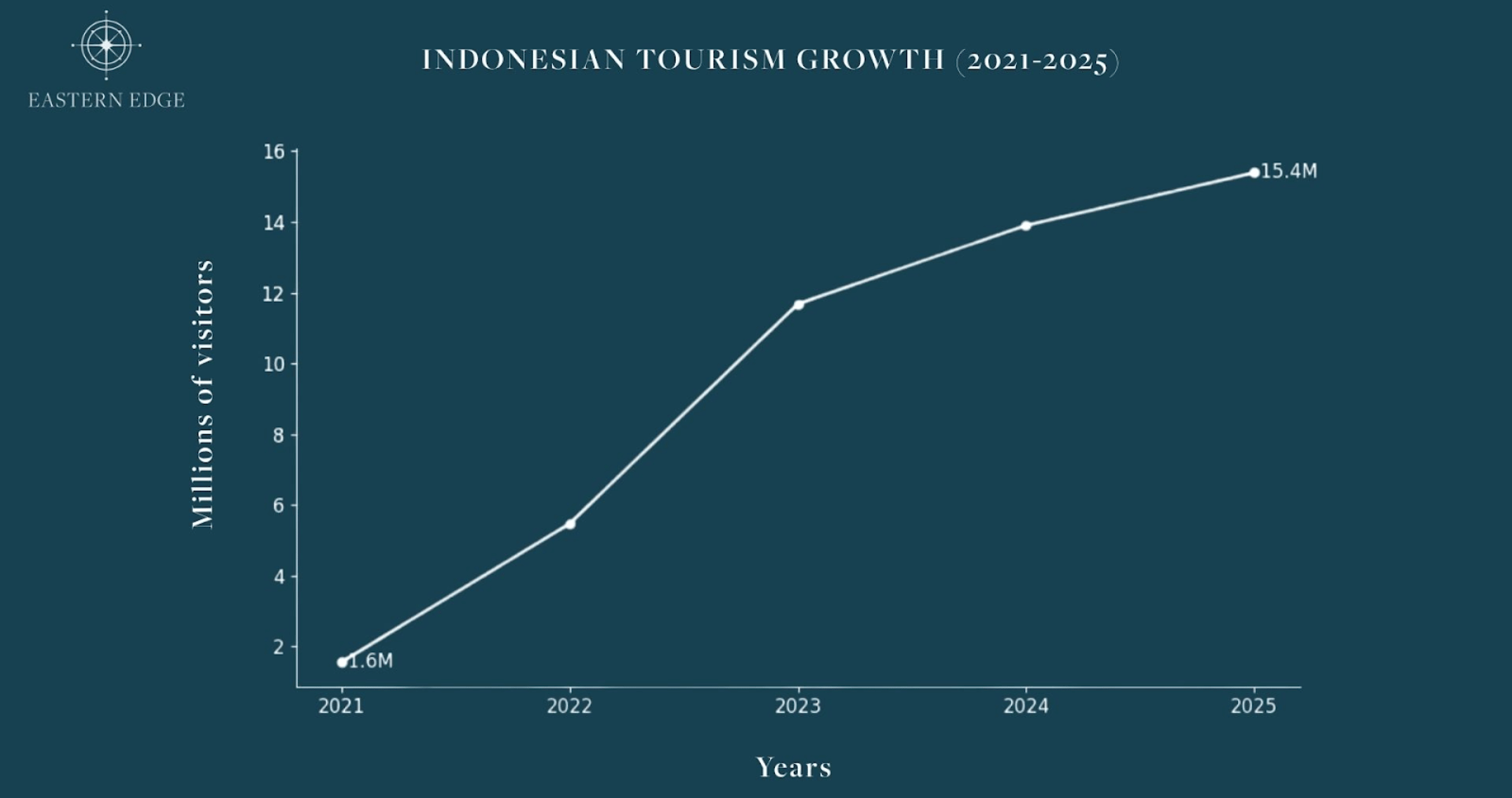
For investors evaluating Indonesia real estate investment, this matters.
But Lombok’s position within that growth is even more interesting.
While Indonesia absorbs millions of visitors, Lombok remains at an earlier stage of exposure. The island already sees over a million annual visitors, yet remains underdeveloped relative to Bali.
This creates a rare asymmetry:
- Demand is real
- Supply is still limited
- Pricing remains accessible
It is precisely this dynamic that underpins Lombok’s tourism growth and supports strong rental yield potential.
From luxury villas to eco villas for sale, the opportunity is not just capital appreciation; it is passive income, driven by increasing occupancy and rising average daily rates.
.png)
Scarcity has evolved
For a long time, scarcity was associated with price.
Today, it is associated with access: the most valuable opportunities are rarely the most visible ones. They are the ones that feel slightly early. Slightly off-radar. Not yet fully articulated. The kind you only recognise if you are already looking in the right direction.
The property that is not on the booking platform.
The allocation that is not publicly released.
The place that, for now, still belongs to those who arrived first.
In that sense, remoteness is not a limitation. It is a filter.
The investors who move differently
There is a reason why certain investors consistently find themselves ahead of the curve.
It is not luck. It is not even information. It is how they think about positioning.
They do not wait for validation.
They do not optimise for visibility.
They do not need consensus.
They build optionality early so that, when the landscape shifts, they are already in place. For them, a second base is not a reaction. It is part of the architecture.

What optionality actually gives you
It does not replace what you already have. It does not require you to move. And it is not about detachment from your primary markets.
What it provides is something more precise.
The ability to expand without committing entirely.
The ability to operate across jurisdictions with continuity.
The ability to hold a real asset that functions both as an investment and as a presence.
In practical terms, it gives you room.
Room to decide later. Room to adapt. Room to move, without needing to rush.
The real question
At a certain level, the question is no longer whether this shift is happening. It is whether you are already positioned within it.
Because by the time a market becomes obvious, the advantage has already been taken. And the investors who benefit from it are rarely the ones who arrived last.
They are the ones who recognised the pattern early. And acted on it. Quietly.


%402x%20(dark).svg)
%402x%20(dark).svg)

%402x.svg)


