
%402x.svg)
Indonesia has become an increasingly attractive destination for international investors looking at real estate in Southeast Asia. In particular, Lombok has emerged as a natural point of interest, often compared to Bali as a less saturated alternative with strong long-term potential.
For those exploring Lombok’s real estate investments, whether that means securing land, acquiring a villa, or entering the market through a development project, the focus is often on location, pricing, and expected returns.
But very quickly, the conversation shifts.
If you relocate, can your partner do the same? And under what conditions?
The answer is yes. However, like many aspects of Indonesian laws for foreigners, the outcome depends on how the structure is set up from the beginning.

Read More: Lombok Property Investment: A Market Entering Its Own Cycle
Understanding the Spouse KITAS
A Spouse KITAS is a limited stay permit issued to a foreign national who is legally married either to an Indonesian citizen or to a foreigner holding a valid KITAS.
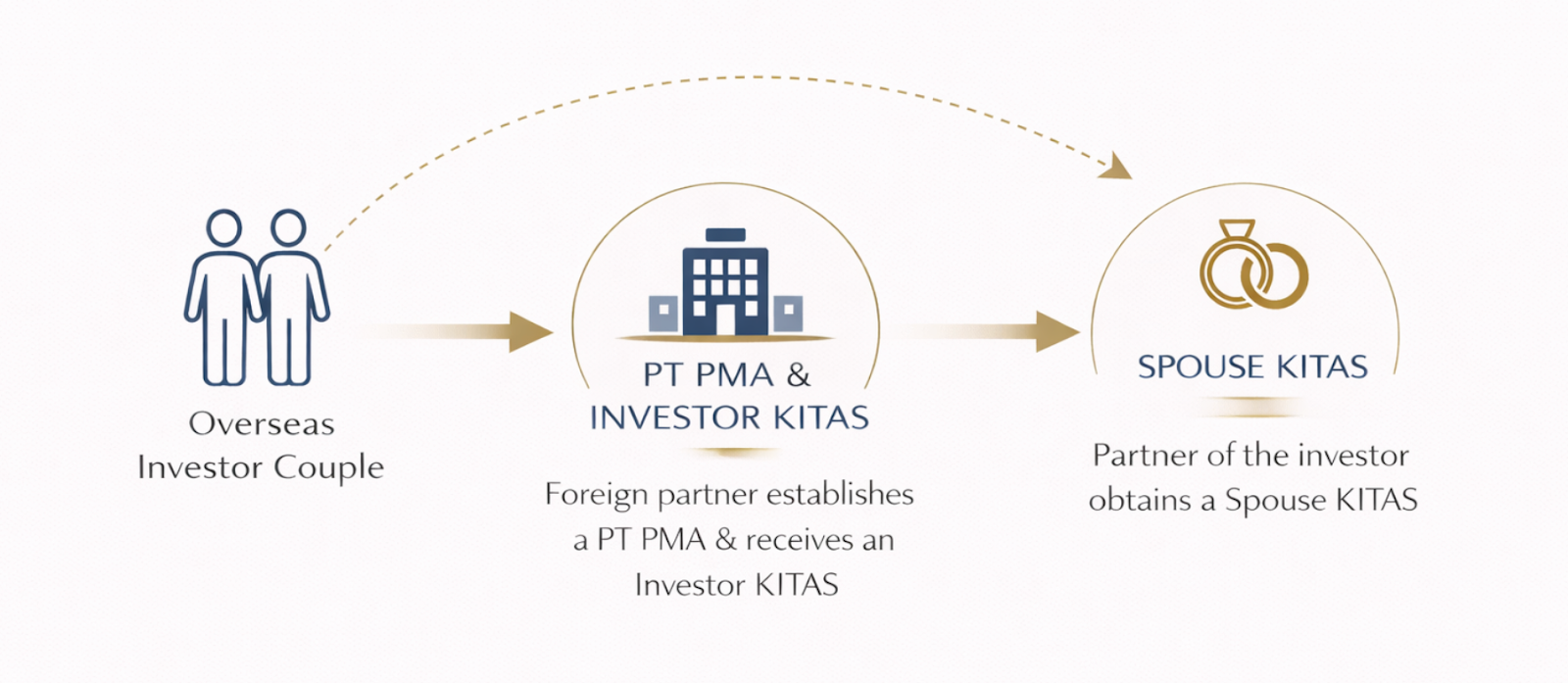
In an investment context, this typically follows a clear path. One partner establishes a PT PMA, which is the standard legal structure used by foreigners to invest in Indonesia, including when they buy property in Lombok or develop a project. That partner then obtains an Investor KITAS, while the second partner applies for a Spouse KITAS as a dependent.
This setup is widely used by investors entering the market, whether they are purchasing a villa, evaluating land near Kuta Lombok, or considering a longer-term property investment in Indonesia.
At a glance, it provides a simple way for couples to relocate together. In practice, however, it introduces an important distinction that is often overlooked.
What the Spouse KITAS Allows
The Spouse KITAS is designed to provide residency, not economic participation.
It allows the holder to live in Indonesia on a long-term basis, move freely in and out of the country, and remain aligned with the duration of the primary visa holder. For investors transitioning from short visits to a more permanent presence often the case when managing a property, this creates stability without unnecessary complexity.
In practical terms, the Spouse KITAS enables:
- Long-term residence in Indonesia
- Multiple entry and exit without reapplying
- A stay duration linked to the main KITAS
For many couples, particularly those entering the market through a single asset such as a villa or a small development, this structure is often sufficient.
Where Most Assumptions Go Wrong
The misunderstanding usually arises when residency is confused with operational access.
Many investors assume that if both partners relocate, they can both participate equally in the investment. This is especially common among those exploring opportunities such as buying a villa in Lombok, managing short-term rentals, or entering the market through off-plan villas.
In reality, the Spouse KITAS does not allow the holder to work locally or generate income within Indonesia.
This means that even if the investment involves rental income from villas in Lombok or a broader strategy aimed at building passive income, the dependent spouse cannot be formally involved in those activities under this visa.
More specifically, a Spouse KITAS holder cannot:
- Work for an Indonesian company
- Receive income within Indonesia
- Take on an operational role within a business
- Sign contracts as an active representative
This distinction may seem technical, but it becomes highly relevant once the investment moves from planning into execution.
How It Fits Within an Investment Structure
Foreign investors typically operate through a PT PMA, which provides the legal framework for participating in real estate investments in Indonesia.
This applies across different types of assets from villas and residential developments to larger resort-style projects or land acquisitions. In Lombok, areas such as Kuta, Mandalika, and the south coast are seeing increasing interest, driven in part by tourism growth and infrastructure development.
The Investor KITAS is directly linked to this structure, allowing the holder to manage the investment and operate within the company.
The Spouse KITAS, by contrast, sits alongside this framework. It allows the partner to live in Indonesia, but without entering the operational or income-generating side of the investment.
This creates a clear division:
- One partner acts as the investor and operator
- The other holds residency without direct involvement
For many investors, particularly those entering the market gradually or testing the waters, this arrangement works well.

When a Different Structure Is Required
As soon as both partners intend to be actively involved, the limitations of the Spouse KITAS become more apparent.
This is often the case when investors move beyond a single asset and begin scaling whether by acquiring multiple properties, developing villas, or managing a portfolio aimed at generating consistent returns.
In these situations, a more independent structure is typically required. This may involve:
- Each partner obtaining their own Investor KITAS
- Structuring both individuals within the PT PMA
- Assigning formal roles within the company
While this approach involves additional steps, it allows both partners to operate legally, receive income, and fully participate in the investment.
Validity and Dependency
Another aspect that is often overlooked is the dependent nature of the Spouse KITAS.
Its validity is tied directly to the primary visa holder. If the main KITAS is not renewed, modified, or cancelled, the dependent visa is affected as well.
For short-term investors, this is rarely an issue. However, for those considering a long-term move something increasingly common among individuals drawn to island living in Lombok or seeking a base in Indonesia, it becomes part of the broader planning process.

Choosing the Right Approach
There is no single structure that works for every investor.
Some couples prioritise simplicity, especially when entering the market with a single property or exploring whether Lombok is the right fit compared to Bali. Others take a more strategic approach from the outset, particularly when they see Indonesia as a long-term base or a key part of their investment portfolio.
Key considerations typically include:
- Whether one or both partners will be actively involved
- Whether income will be generated locally
- The level of control required within the investment
- Long-term residency and expansion plans
The right structure is not necessarily the most complex one it is the one that reflects how the investment will actually function in practice.
Residency as Part of the Investment Framework
In Indonesia, company structure, property ownership, and residency are closely connected, but they are not interchangeable.
Understanding how these elements interact is essential, particularly when navigating questions such as how foreigners can own property, or how to structure an investment correctly from a legal and operational perspective.
The Spouse KITAS sits within the residency layer, but its impact extends into how the overall investment operates especially in terms of control, flexibility, and long-term planning.

A Structure That Shapes the Experience
For many investors, entering Indonesia is no longer just about acquiring an asset.
It is about building a presence spending time on the ground, understanding the market, and in some cases, creating a lifestyle that goes beyond the investment itself.
Within that context, the Spouse KITAS plays a specific role. It enables relocation as a couple, but within defined boundaries.
Understanding those boundaries early ensures that both the investment and the move are structured in a way that remains sustainable over time.


%402x%20(dark).svg)
%402x%20(dark).svg)

%402x.svg)


