
%402x.svg)
For years, the narrative around foreign ownership in Indonesia has been framed in overly simplistic terms: you either “can” or “cannot” own property.
The reality is more nuanced and far more interesting.
Investors entering markets like Lombok are no longer asking whether ownership is possible. They are asking how to do it properly. And increasingly, the answer is not leasehold, not informal arrangements, but something more structured: the PT PMA.
Read More: Why Smart Investors Build Optionality, Not Safe Havens
A structure, not a shortcut
A PT PMA (foreign-owned limited liability company) is not a workaround. It is the legal framework explicitly designed for foreign capital entering Indonesia.
In practical terms, it allows you to operate within the system, not around it.
Formally regulated under Indonesian investment law and overseen by the Investment Coordinating Board (BKPM), it allows foreign individuals, entities, and even governments to establish a fully compliant corporate presence in the country.
This is particularly relevant in emerging destinations like Lombok, where the real estate market is still developing and early positioning matters. Whether you are considering land, a villa development, or a managed resort-style investment, the structure you choose will define your level of control.
You are not holding a contract; you are holding a company.
And that distinction changes everything.

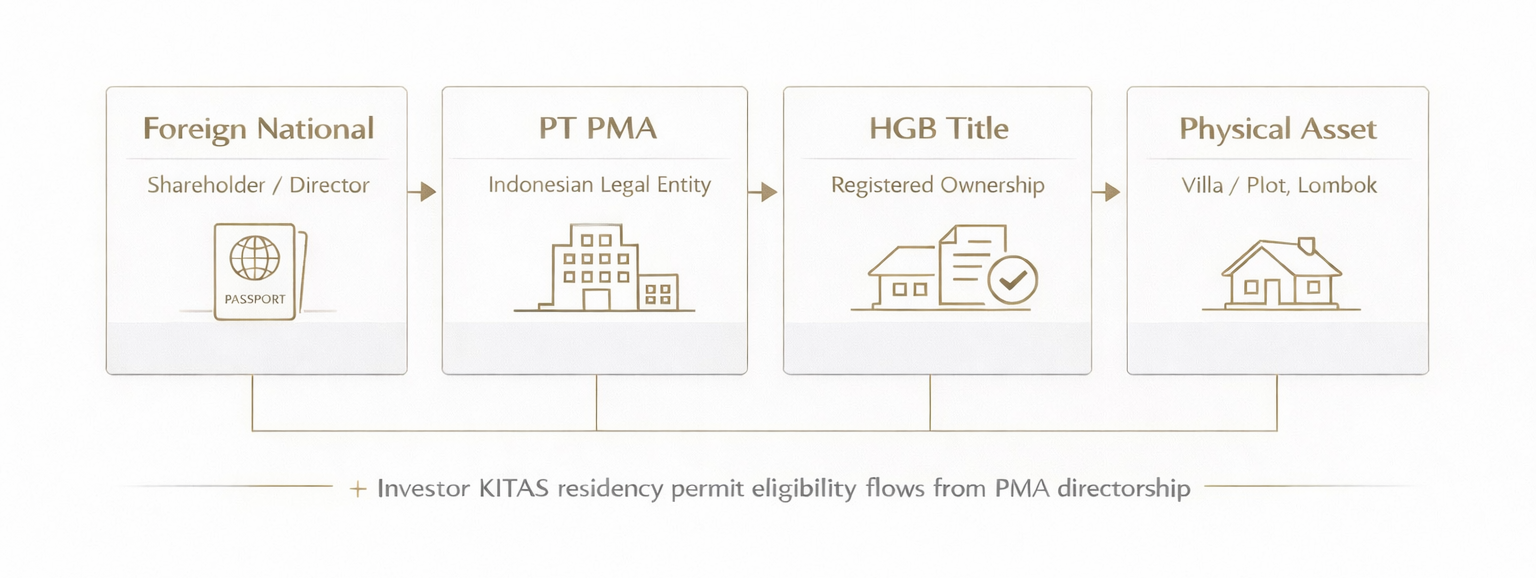
Ownership through structure
Unlike leasehold arrangements, where private agreements govern rights, a PT PMA operates within the formal legal system.
The company itself holds the asset, typically under a Hak Guna Bangunan (HGB) title. Granting the right to build and own structures on land for up to 80 years.
At first glance, this may seem like an additional layer. In reality, it removes ambiguity.
Ownership is not based on trust or contractual interpretation. It is defined legally through shareholding in the company. For investors used to more mature markets, this clarity is often what makes Indonesia investable at scale.
Control, scalability, and intent
What attracts experienced investors is not just legality, but control.
A PT PMA allows you to manage your asset directly, operate it commercially, and, if desired, expand across multiple properties. It also opens the door to residency options, making it relevant for those considering a longer-term presence in Indonesia.
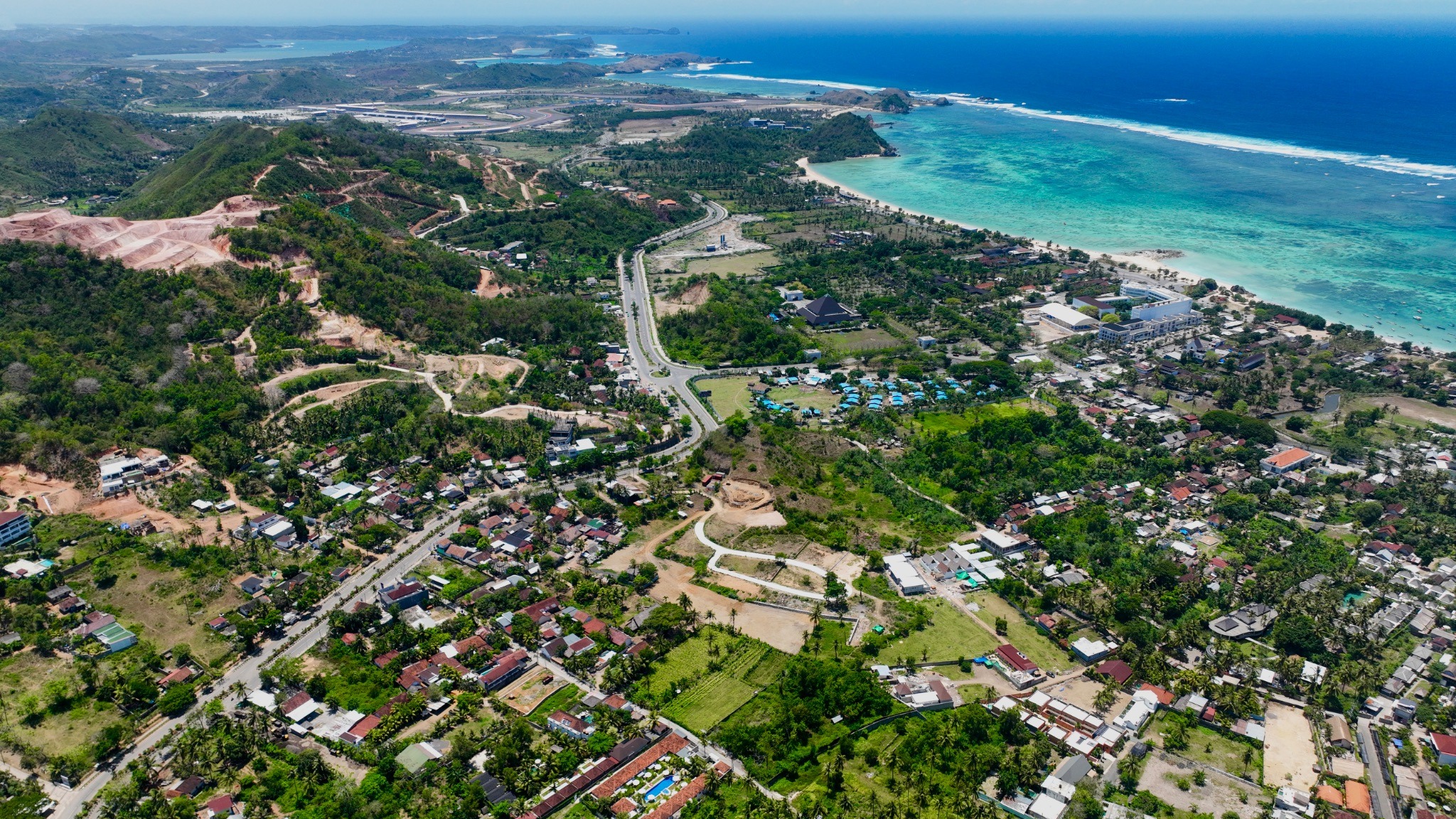
This becomes particularly important in places like South Lombok, where areas around Kuta and the Mandalika region are still in a growth phase. Investors are not simply buying a single unit; they are building a position in a market that is evolving.
The real cost of doing it properly
Of course, this level of control comes with commitment.
To establish a PT PMA, investors are required to inject an initial paid-up capital of approximately $160,000 (IDR 2.5 billion). Over the company's lifetime, the total investment plan is expected to reach around $640,000 (IDR 10 billion) though this is typically deployed incrementally through business operations and assets.
The setup process itself is relatively efficient, usually completed within 3 to 4 weeks, but requires proper legal structuring from the outset.
Where most investors underestimate the process is in the true cost of acquisition.
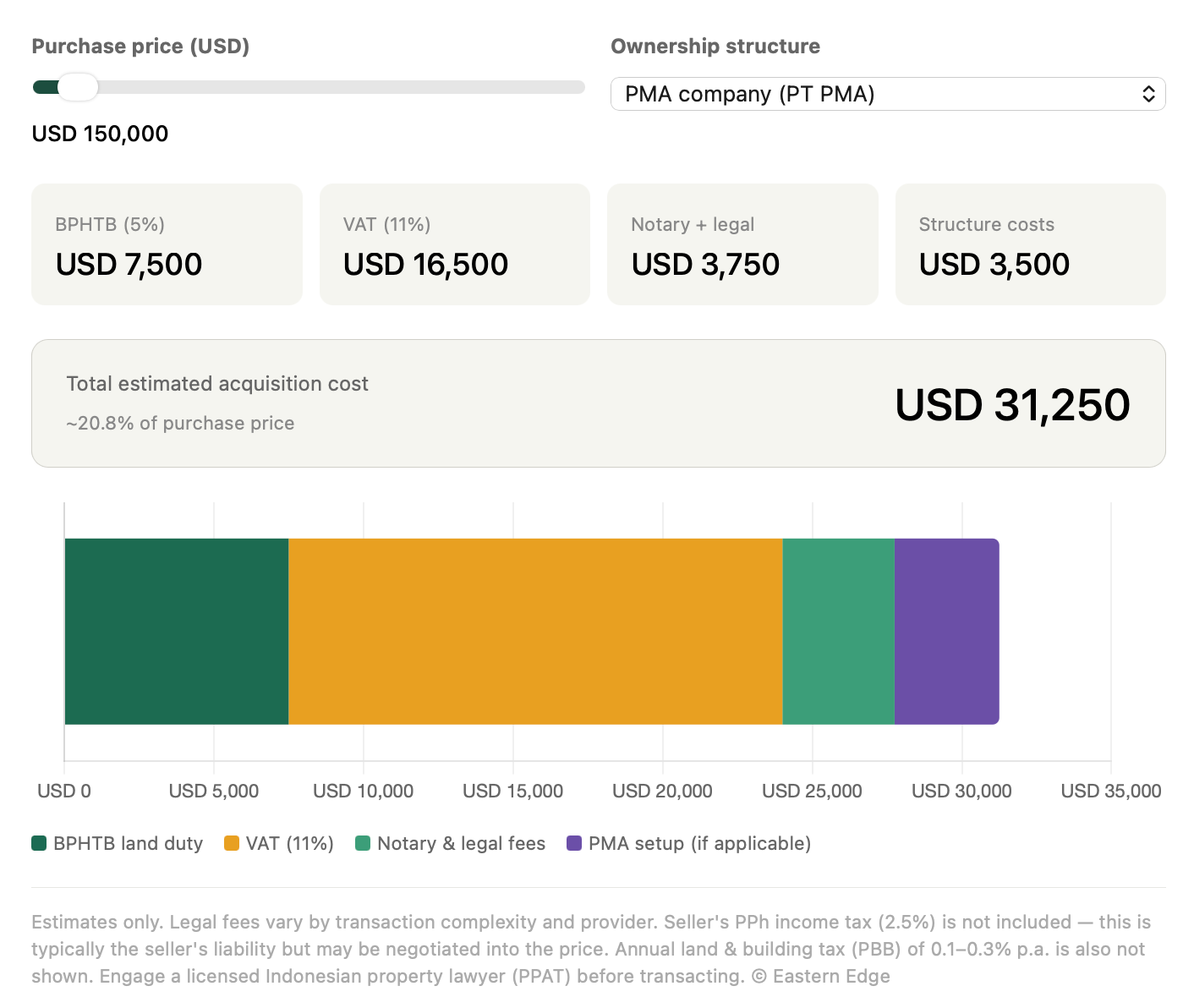
For a property priced at $150,000, a typical breakdown would be:
- Buyer Tax (5%) → $7,500
- VAT (11%) → $16,500
- Notary fee (1%) → ~$1,500
- Legal fees → ~$2,200
- PMA setup costs → ~$3,500
Total estimated acquisition cost: ~$31,750.
Ongoing compliance and accounting costs are relatively contained, typically around $2,000 per year.
To make this clearer, we usually model these costs dynamically depending on the investment. These are not hidden costs. They are the price of operating within a system that provides legal protection something that becomes increasingly important as investment sizes grow.
You can explore this further using our Indonesia property acquisition cost calculator.

Understanding taxation: simpler than it seems
One of the most overlooked aspects of investing through a PT PMA is how taxation actually works in practice.
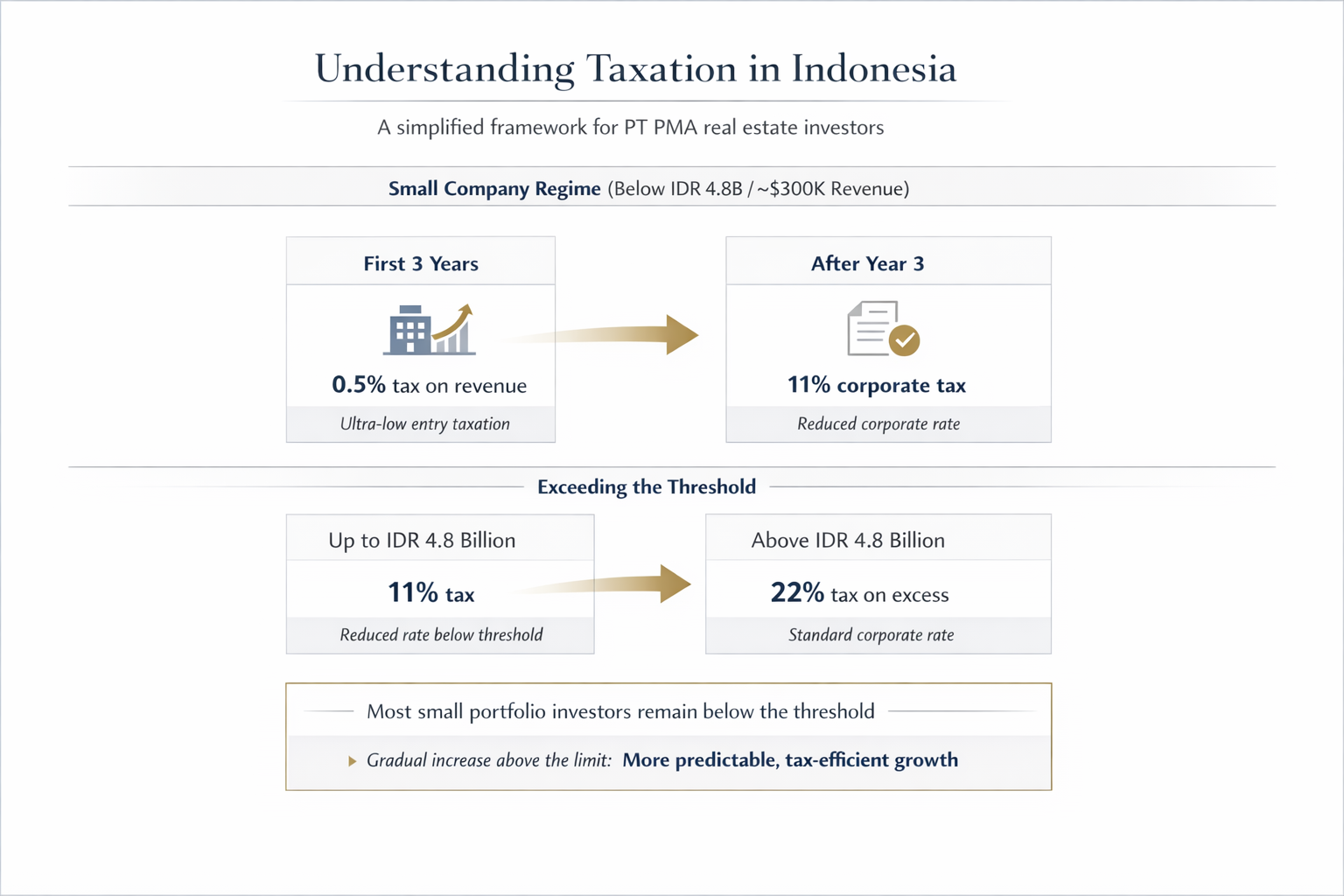
For companies generating less than IDR 4.8 billion per year (approximately $300,000 USD), Indonesia applies a simplified regime:
- First 3 years → 0.5% tax on revenue
- After 3 years (below threshold) → 11% corporate tax
For many real estate investors particularly those holding a limited number of rental assets, this threshold is often sufficient, making the structure relatively efficient in the early and mid stages.
Once the company exceeds IDR 4.8 billion (~$300,000/year), taxation becomes progressive:
- The portion of income up to IDR 4.8 billion continues to be taxed at 11%
- Only the portion above that threshold is taxed at the standard 22% corporate rate
In practice, this means that even as a portfolio grows, the effective tax rate increases gradually rather than abruptly a detail that is often overlooked but highly relevant when modeling long-term returns.
From acquisition to income
The acquisition process itself is structured and transparent.
The company enters into a formal Sale and Purchase Agreement before a notary, ensures the land title is correctly converted (typically to HGB), and completes the transfer following tax settlement.
From there, the asset can be operated commercially.
In many cases, particularly within managed developments, properties are placed into rental programs. Income is distributed periodically, often quarterly, with typical structures allocating around 45-65% to the owner.
Rental income is subject to a final tax regime, commonly at 10%, providing relative simplicity compared to more complex taxation systems elsewhere.
For investors looking at Lombok, this is where the opportunity becomes tangible: a growing tourism market combined with a relatively early-stage real estate cycle.

Why serious investors avoid shortcuts
One of the most persistent concerns among foreign buyers in Indonesia revolves around so-called “nominee” structures arrangements where property is held in the name of a local individual.
On paper, these can appear simple. In practice, they introduce a fundamental issue: the legal title holder retains full rights over the asset.
The PT PMA exists precisely to eliminate this risk.
By embedding ownership within a company structure governed by Indonesian law, it replaces informal trust-based arrangements with enforceable legal rights.
It is more complex. But it is also meaningfully more secure.

Not for everyone and that’s the point
The PT PMA is not designed for every buyer.
Its structure makes it most suitable for investors who take a long-term view, plan to scale, or want full control over their assets.
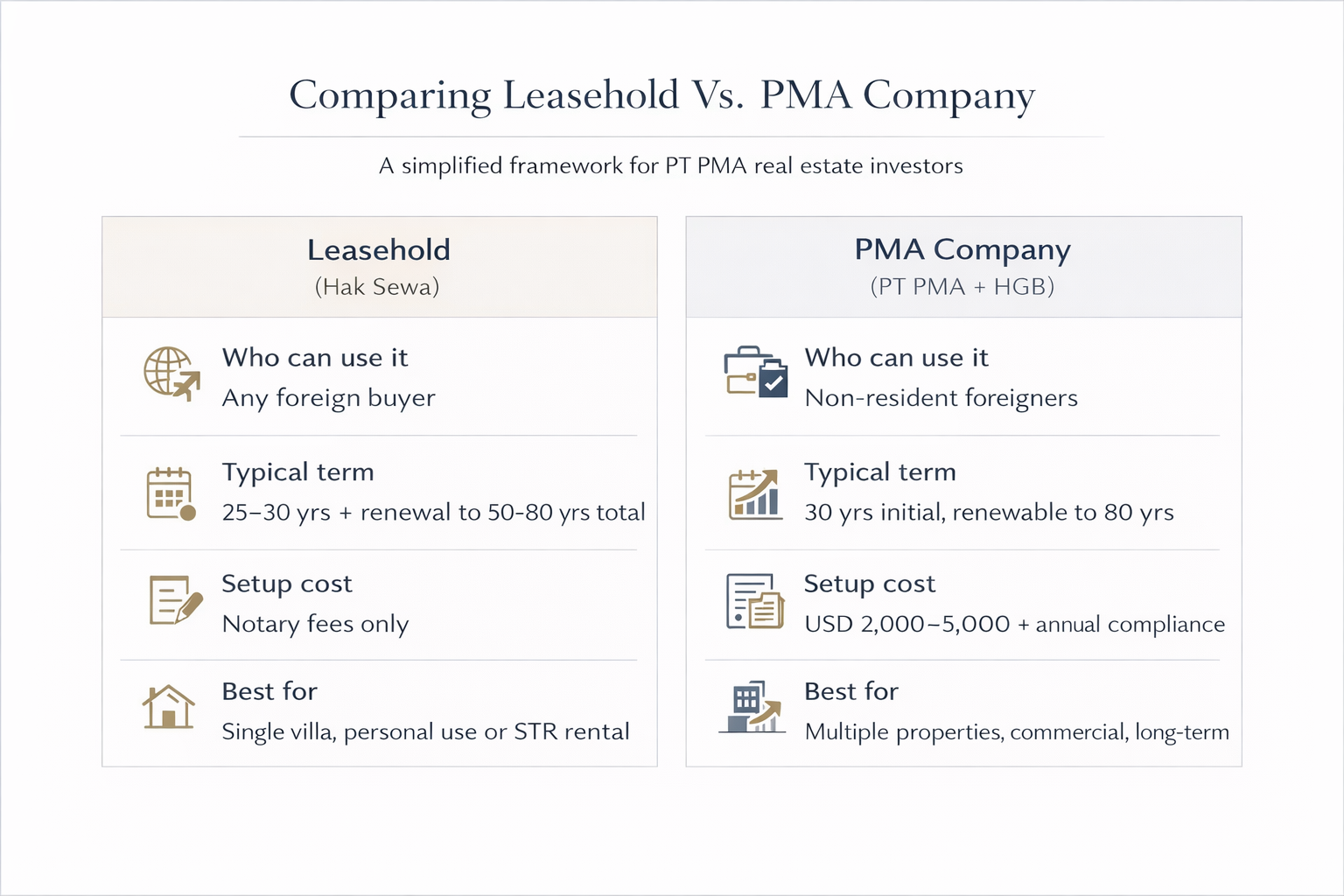
For others particularly those purchasing a single lifestyle property leasehold can still be a valid option.
But the distinction is important.
Leasehold is a position.
A PT PMA is a platform.
A shift in how capital moves
What is becoming increasingly clear is that foreign investment into markets like Indonesia is evolving.
It is no longer driven by opportunistic entry or short-term arbitrage. It is structured, deliberate, and increasingly institutional in mindset.
Investors are not simply asking where to buy. They are asking how to build optionality legally, operationally, and financially.
And in that context, the PT PMA is not just a legal mechanism.
It is a reflection of how seriously capital chooses to operate.


%402x%20(dark).svg)
%402x%20(dark).svg)

%402x.svg)


