
%402x.svg)
Bali has already proven the demand. Lombok is entering the phase where that demand is beginning to reshape the market.
For investors looking at Indonesian property in 2026, the question is no longer simply which island is more popular. Bali and Lombok offer two very different propositions: one is a mature international destination with established demand and pricing, while the other is still developing its infrastructure, tourism ecosystem and property market.
That difference matters.
For some investors, Bali’s liquidity and established rental market remain attractive. For others, Lombok offers something harder to find in a mature destination: lower entry points, less competition and more room for long-term growth.
Here is how the two markets compare — and why the stage of the market may matter more than the destination itself.
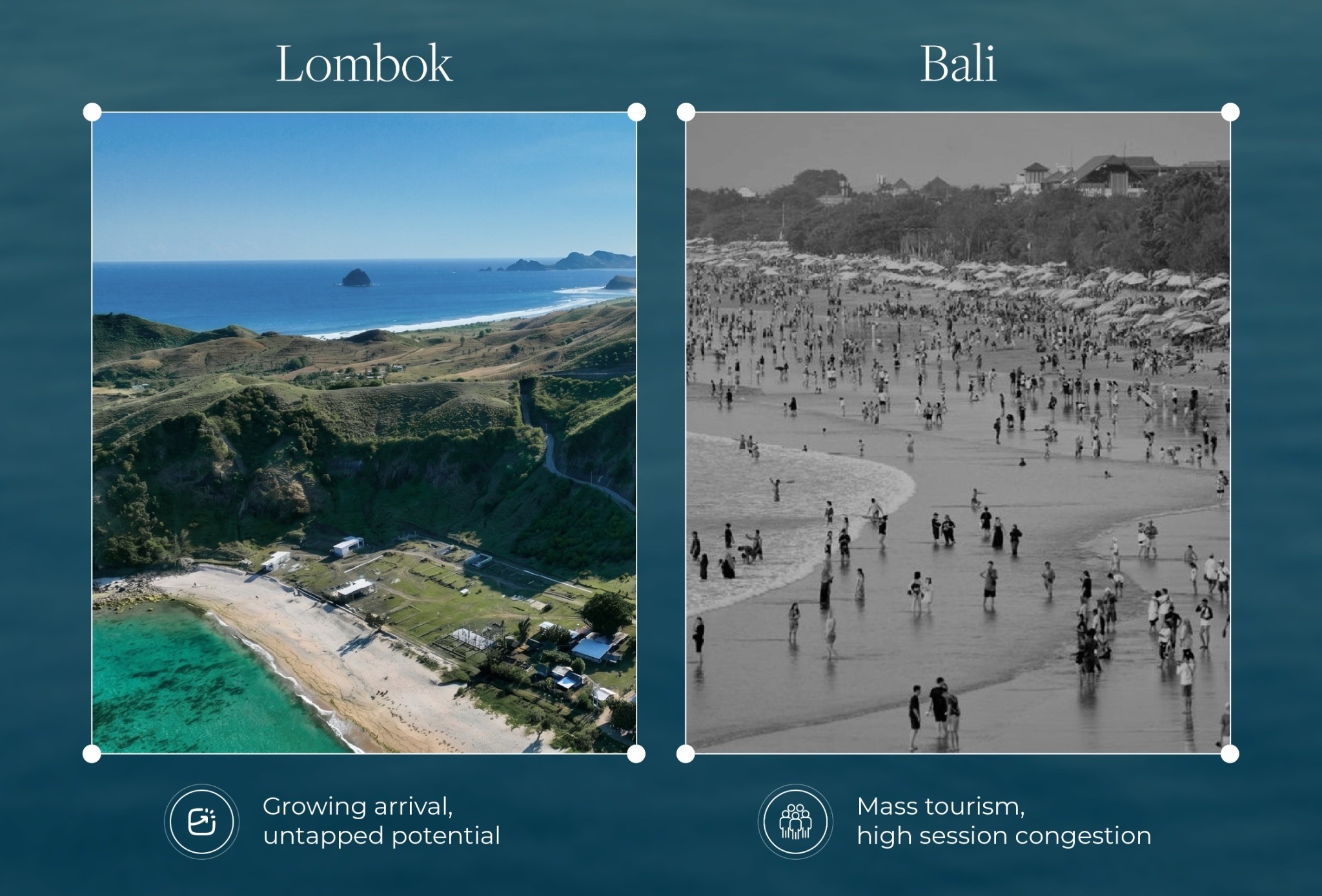
01 — Tourism: Demand Is Growing, but the Market Is Not Yet Saturated
Room to grow, without the density of a mature destination.
Read More: South Lombok Investment Guide: Kuta, Selong Belanak, Torok, Pengantap
Bali has one of the strongest tourism ecosystems in Southeast Asia. In 2025, the island recorded almost 6.95 million direct international tourist arrivals, up 9.72% from the previous year.
That scale creates a major advantage: established demand.
But it also creates a different investment environment. Prime areas have become highly developed, competitive and expensive, with limited room for new supply in the most desirable locations.
Lombok is at a different point in its development.
Tourism is growing around destinations such as Kuta, Mandalika, Selong Belanak and the wider south coast, while the island still has significant areas that remain relatively undeveloped.
The opportunity is therefore not simply more tourists. It is the potential for tourism growth to translate into a larger property market while entry points remain below those of comparable established destinations.
The development of The Mandalika is an important part of that story. ITDC reported more than 285,000 visitors to the area in January–April 2026, alongside rising airport passenger traffic and expanding connectivity.
For investors, the distinction is important: Bali offers proven demand. Lombok offers demand combined with development runway.
02 — Market Density: Space Still Has Value
Established demand versus emerging supply.
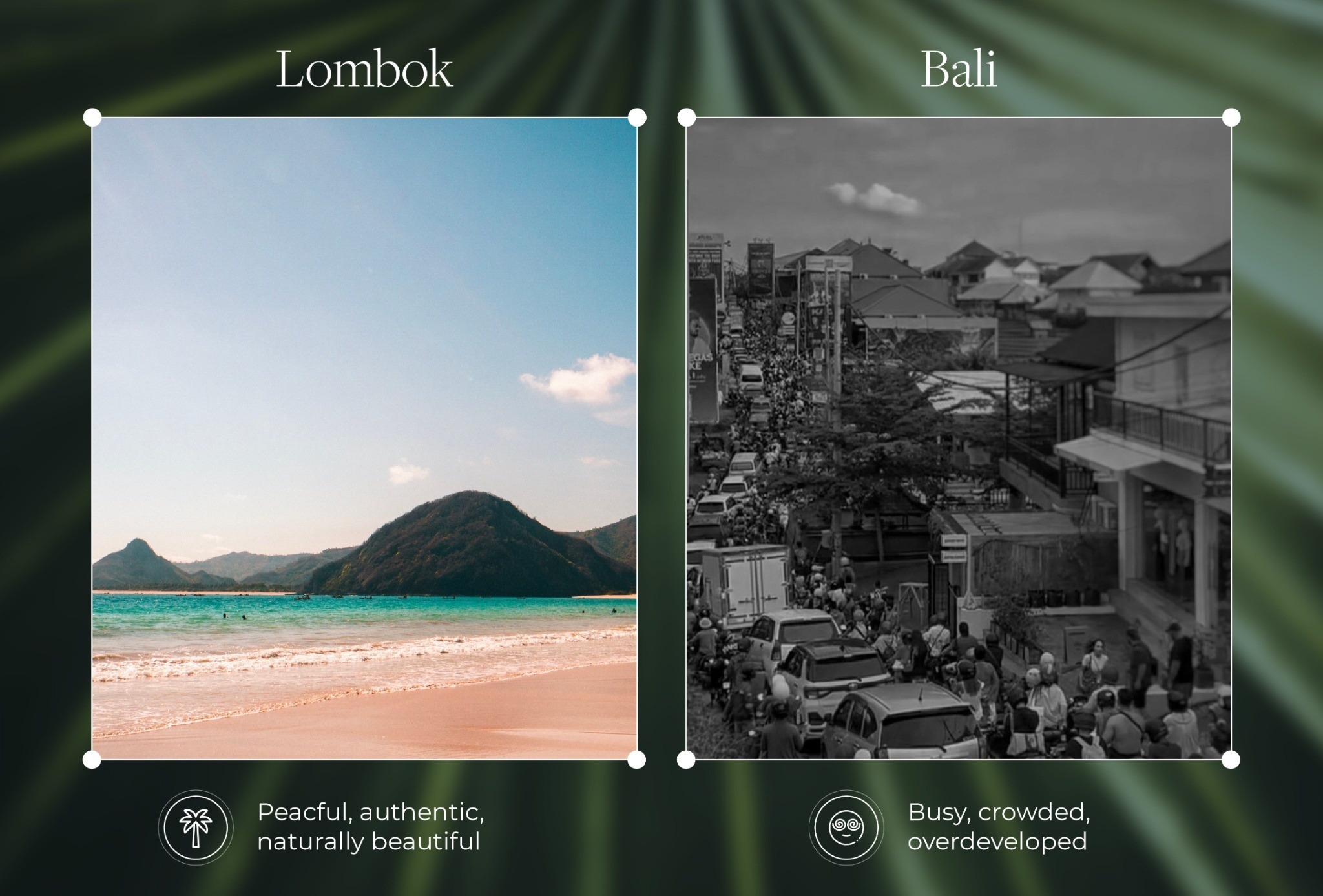
One of Lombok's most compelling characteristics is something that is difficult to replicate once a destination has matured: space.
Bali's popularity has created enormous demand for hospitality, restaurants, villas and commercial property. That demand has also brought significant development density to many of its best-known areas.
Lombok has not reached the same level of saturation.
For investors, this creates a different competitive landscape.
There are fewer established operators, fewer comparable properties and less existing inventory in many emerging locations. That creates additional risk — but also creates the possibility of establishing an asset before the surrounding market becomes fully developed.
The important distinction is that limited supply is only valuable when demand is following it.
Lombok's investment case therefore depends on selecting locations where tourism, infrastructure and accessibility are developing alongside property supply.
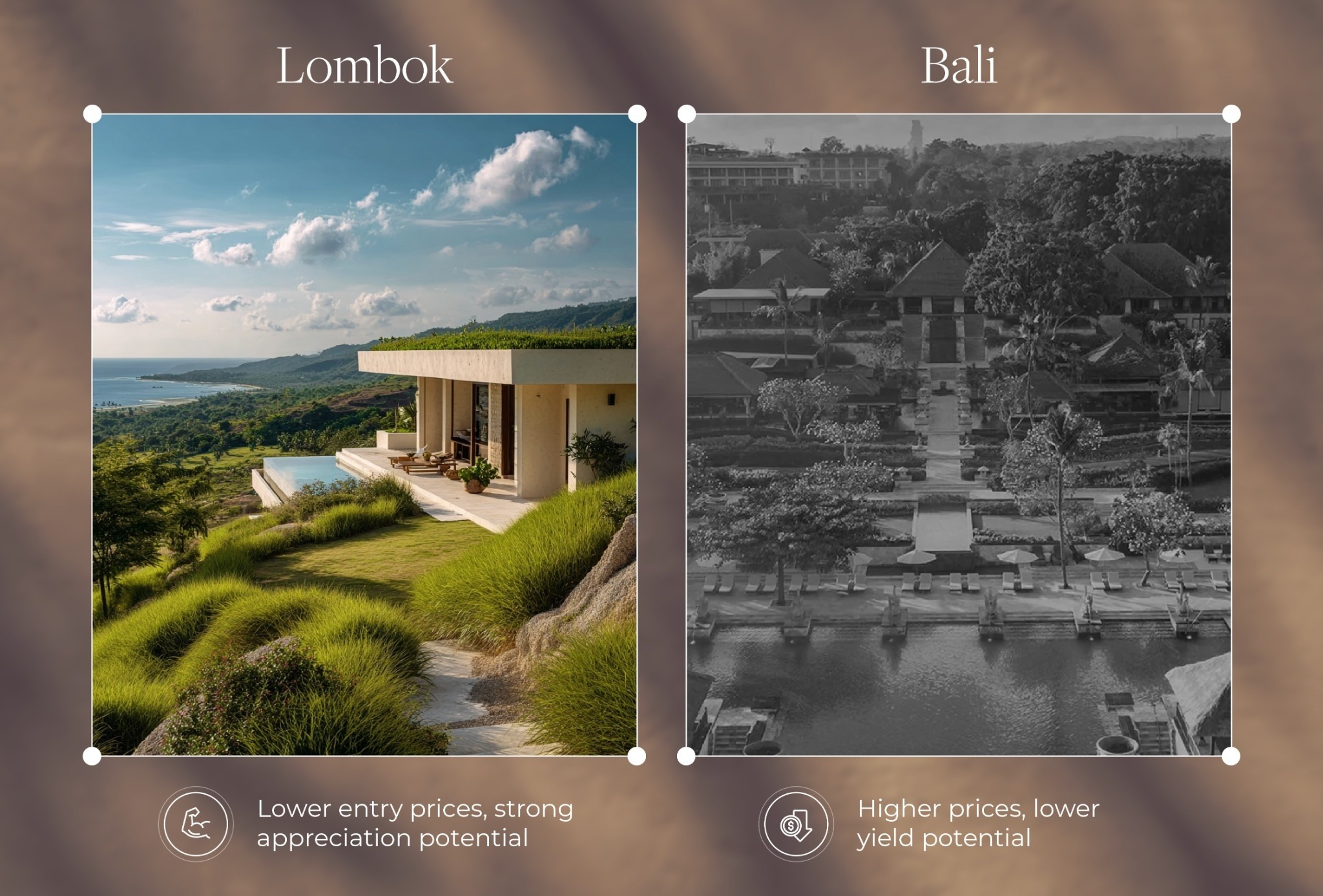
03 — Property Prices: Entry Point Still Matters
More room between today's price and tomorrow's potential.
Read More: Rafa Nadal Tennis Center Torok Bay: What It Means for South Lombok
One of the clearest differences between the two markets is the cost of entering them.
Prime Bali property has benefited from years of international demand, infrastructure and development. That maturity has pushed land and completed property prices significantly higher.
Lombok remains comparatively accessible, particularly outside the most established areas of South Lombok.
Current market reports put investment-grade South Lombok villas broadly around €95,000–€350,000, while comparable Bali properties can sit considerably higher depending on location and specification. These figures should be treated as market ranges rather than universal valuations.
That difference changes the investment equation.
A lower entry price does not automatically make a property a better investment. What matters is what you are buying, where you are buying it, and what the surrounding market can support.
But when infrastructure, tourism and demand are still expanding, entering before a destination reaches the pricing of a mature market can create a larger potential appreciation runway.
04 — Rental Yield: Income Depends on What You Buy
The right property can make the difference.
Rental yield is often presented as the easiest way to compare Bali and Lombok.
It is also one of the easiest numbers to misunderstand.
A property's headline yield depends on its purchase price, nightly rate, occupancy, management costs, maintenance, taxes and operating structure. Comparing a premium Lombok villa with a lower-performing Bali property — or gross yield with net yield — can create a very misleading picture.
Current 2026 market estimates place gross villa yields broadly around 8–12% in established Bali markets and around 12–20% for selected Lombok assets, although actual performance varies substantially by location, property type and operator.
The more useful question is therefore not:
“Which island has the higher yield?”
It is:
“What does the yield look like relative to the purchase price, occupancy and long-term value of the asset?”
This is where Lombok can become particularly interesting.
Lower acquisition costs can create stronger yield potential when paired with a well-positioned rental property, while limited competition in emerging locations can provide room for strong nightly rates as demand develops.
At the same time, Bali's deeper tourism market can provide greater consistency and liquidity.
Income and appreciation should therefore be evaluated together — not separately.
05 — Infrastructure: Investing Before the Destination Is Finished
Infrastructure changes what a location can become
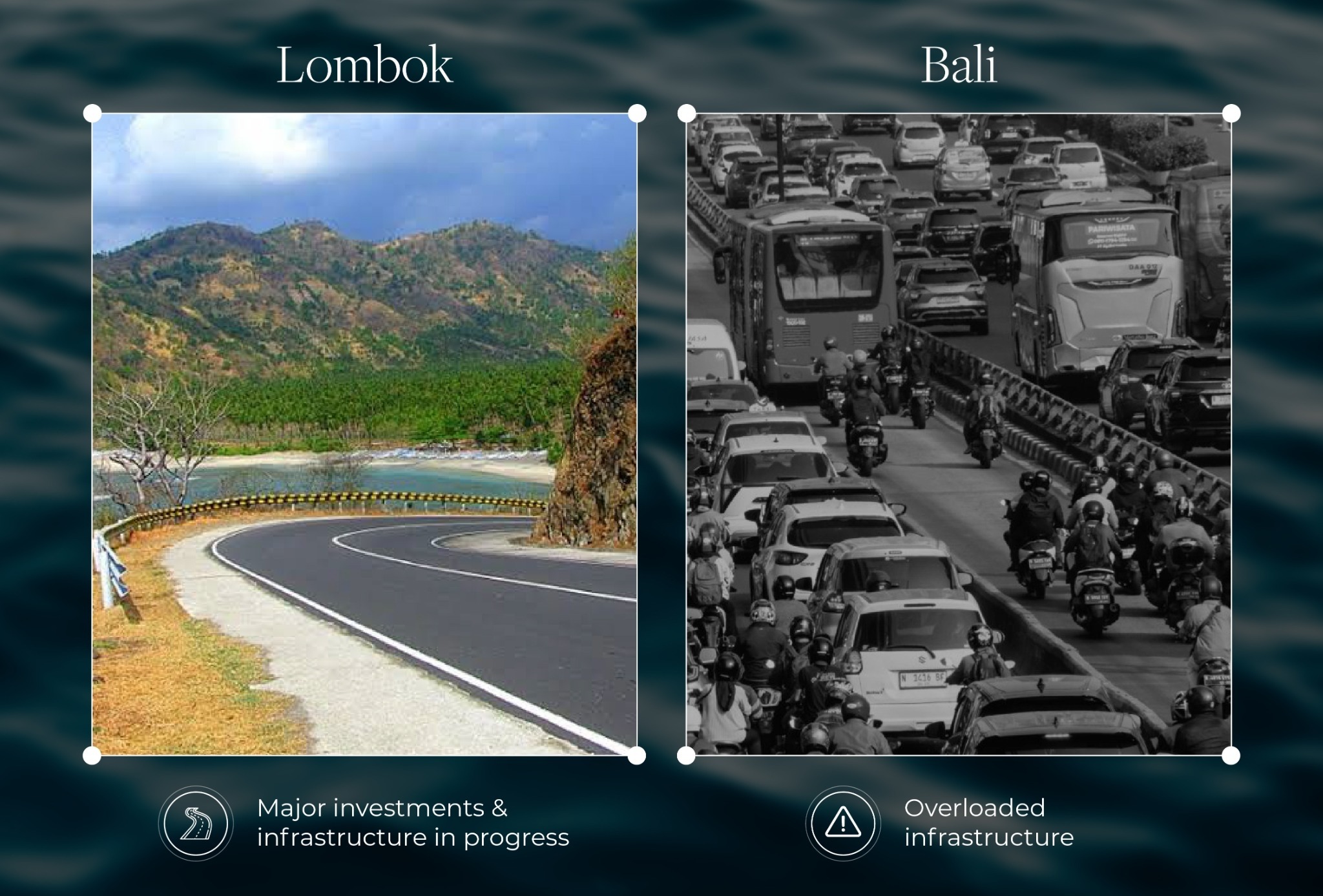
Infrastructure is one of the strongest indicators of how an emerging property market can evolve.
Bali already has a mature infrastructure network, international connectivity and established tourism infrastructure. That reduces uncertainty — but much of that infrastructure growth has already been priced into the market.
Lombok is still building.
The Mandalika area continues to receive investment into roads, utilities, public facilities and tourism infrastructure. ITDC reported cumulative investment of more than Rp6 trillion in The Mandalika by the end of 2025, alongside continued development of connectivity and utilities.
Airport connectivity is also improving. Between January and April 2026, Lombok International Airport recorded 850,319 passengers, approximately 18.4% higher than the same period a year earlier.
This is why infrastructure matters to property investors.
A road, airport connection, resort, marina or commercial district is not simply a public project. Over time, it can change how accessible a location is, how much demand it can support and what buyers are willing to pay for property nearby.
06 — Legal Structures: How Foreign Buyers Typically Invest
The legal framework is the same across Indonesia, but the way foreign buyers structure property investments can differ between Bali and Lombok.

Leasehold is one of the most common routes for foreign buyers. In Bali, villa investments are often structured around an initial 25–30 year lease, with extension options negotiated as part of the agreement. Depending on the terms, total control of the property can extend to 50–80 years.
Lombok also offers leasehold opportunities, particularly for villas and individual properties. However, as the market is still developing, investors may also encounter larger land and development opportunities where a PT PMA structure can be more appropriate.
PT PMA is a foreign-owned Indonesian company that can hold certain land rights, including HGB (Hak Guna Bangunan). It generally makes more sense for commercial projects, larger developments or investors planning to hold multiple assets rather than a single villa.
Hak Pakai, or Right of Use, is another option available to qualifying foreigners, although it is less commonly used for investment-focused property.
What This Means for Investors
In Bali, 25–30 year leaseholds are particularly common for villa investments, often with extension options agreed as part of the original arrangement. With established land values already reflected in many prime locations, leasehold can provide a more accessible way to enter the market without acquiring the underlying land.
In Lombok, leasehold remains an option, but the developing market creates opportunities beyond the typical villa lease. Lower land values and larger undeveloped areas can make PT PMA structures and longer-term development strategies more relevant for certain investors.
The key is not simply choosing Bali or Lombok, but choosing a structure that matches the asset, investment horizon and intended use.
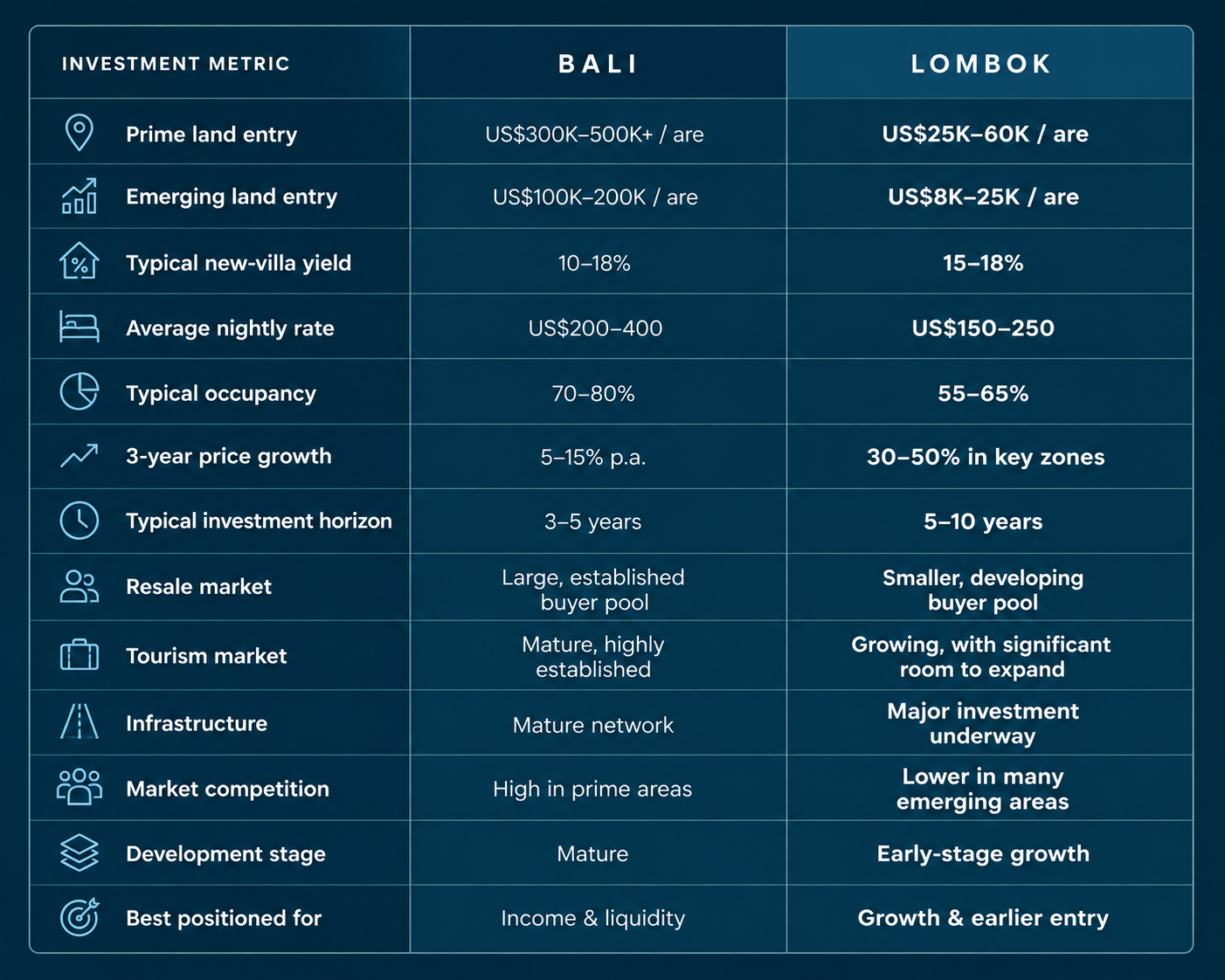
Bali vs Lombok — The Numbers Behind the Opportunity
Bali: The Case For and Against
Where Bali has the edge:
- Established demand — a deep international tourism and rental market supports consistent occupancy in proven locations
- Stronger liquidity — a larger pool of local and international buyers can make resale easier
- Mature infrastructure — established transport, hospitality, services and amenities reduce development risk
- Proven rental ecosystem — experienced operators and established booking channels make income generation more predictable
- Shorter investment horizon — the maturity of the market can suit investors looking for a more established 3–5 year strategy
Where Bali becomes more challenging:
- Higher acquisition costs — prime land and property prices have already risen substantially
- Greater competition — investors are competing within a highly developed property and hospitality market
- More limited room for expansion — prime areas have less undeveloped land and greater development constraints
- Lower upside from market expansion — much of the island's growth story is already established
- More complex planning environment — zoning and development restrictions can be significant in sought-after areas
Lombok: The Case For and Against
Where Lombok has the edge:
- Lower entry point — land and property remain comparatively accessible in many emerging areas
- Growth runway — tourism, infrastructure and development are still expanding
- Greater land availability — more room for new projects as the market develops
- Early-stage positioning — investors can enter locations before they reach the pricing and density of mature destinations
- Development potential — opportunities range from individual villas to larger land and hospitality projects
Where Lombok requires more consideration:
- Less liquidity — the resale market is smaller than Bali's
- Developing rental market — occupancy and nightly rates vary more significantly by location
- Infrastructure still evolving — some areas remain dependent on future infrastructure improvements
- Higher location risk — choosing the right micro-market matters considerably more in an emerging destination
- Longer horizon — the strongest investment case is generally built around a 5–10 year perspective, rather than a quick exit
The Investor Takeaway
Neither market is universally better. They offer different risk-return profiles.
Bali is the more established proposition: deeper demand, greater liquidity and a mature tourism ecosystem, but with higher entry costs and less room for market-wide expansion.
Lombok is the earlier-stage proposition: lower entry points, expanding infrastructure and greater development potential, balanced against a smaller resale market and the need for more careful location selection.
For investors looking beyond immediate income and considering where the next phase of value creation may happen, Lombok presents a compelling opportunity.
The advantage is not simply buying in a cheaper market. It is entering the right location while there is still room for that location to mature.


%402x%20(dark).svg)
%402x%20(dark).svg)

%402x.svg)


